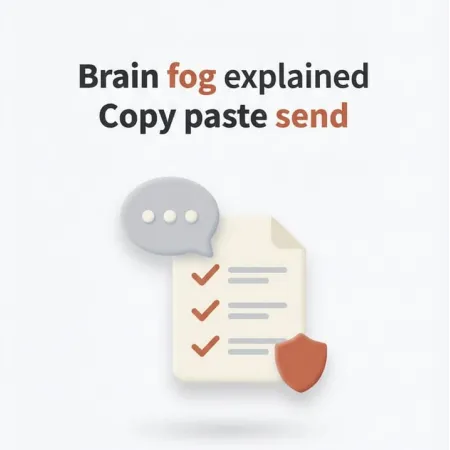
Brain fog explained AI prompt thumbnail showing chat bubble, checklist, and shield icon for menopause coaches to send a warm, non-medical client explanation with clinician safety line

30 mins → 4 mins per explanation

Built-in safety boundaries

Uses their exact words

Reusable for any symptom

Category

Communication

Brain fog explained AI prompt thumbnail showing chat bubble, checklist, and shield icon for menopause coaches to send a warm, non-medical client explanation with clinician safety line

30 mins → 4 mins per explanation

Uses their exact words

Built-in safety boundaries

Reusable for any symptom

Brain fog explanation prompt

Free

Turn "I keep forgetting words" into a validating, educational message in 4 minutes.

$0.00

value

The problem

Your client just said: "I keep forgetting words. Am I losing my mind?" You want to explain. Validate. Educate. But not diagnose. Not prescribe. Not cross the line. You stare at blank email for 30 minutes. Delete sentences. Rewrite. Second-guess every word. Worry you've said too much. Or not enough.

This prompt writes it in 4 minutes.

What you get

1 complete AI prompt for explaining brain fog to individual clients.

Outputs: 4-6 sentence personalized message. Validates, educates, normalizes, reassures without diagnosing.

Includes: Variable guidance (what to include, what to avoid), sample output with safety notes, reusable structure for other symptoms.

Questions About This Prompt

Quick answers to help you decide if this is right for you.
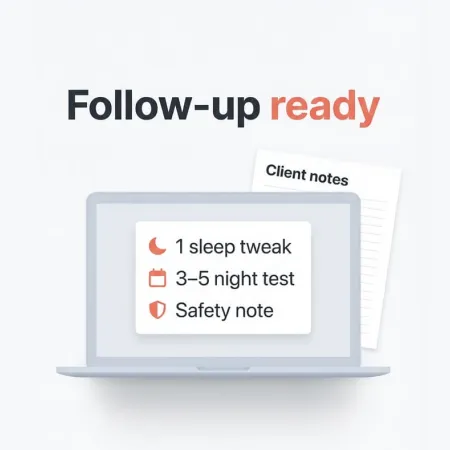
Who is this prompt for?

This is for you if clients ask "What's happening to my brain?" and you spend 30 minutes crafting explanations while worrying about scope boundaries. Not for you if you're a healthcare provider who can diagnose symptoms.

How do I know this won't sound too medical?

The prompt includes explicit constraints telling your AI tool to avoid diagnostic language, medical jargon, and clinical interpretations. The safety boundaries are spelled out in the instructions.

Will this work for other symptoms?

Yes, the structure is adaptable. Once you understand how it works for brain fog, you can modify it for hot flashes, sleep issues, mood changes, joint pain, and other common symptoms.

What if the output sounds scripted?

You'll edit 10-20% to add your voice and style. The prompt creates the foundation. Your personality and care finish it. Uses client's exact words so validation lands immediately.

What if my client's brain fog is severe?

Every output includes a line directing them to talk to their healthcare provider if symptoms are significantly impacting daily life or causing concern. You're educating and signposting, not diagnosing or treating.

Who is this prompt for?

This is for you if clients ask "What's happening to my brain?" and you spend 30 minutes crafting explanations while worrying about scope boundaries. Not for you if you're a healthcare provider who can diagnose symptoms.

How do I know this won't sound too medical?

The prompt includes explicit constraints telling your AI tool to avoid diagnostic language, medical jargon, and clinical interpretations. The safety boundaries are spelled out in the instructions.

Will this work for other symptoms?

Yes, the structure is adaptable. Once you understand how it works for brain fog, you can modify it for hot flashes, sleep issues, mood changes, joint pain, and other common symptoms.

What if the output sounds scripted?

You'll edit 10-20% to add your voice and style. The prompt creates the foundation. Your personality and care finish it. Uses client's exact words so validation lands immediately.

What if my client's brain fog is severe?

Every output includes a line directing them to talk to their healthcare provider if symptoms are significantly impacting daily life or causing concern. You're educating and signposting, not diagnosing or treating.

Who is this prompt for?

This is for you if clients ask "What's happening to my brain?" and you spend 30 minutes crafting explanations while worrying about scope boundaries. Not for you if you're a healthcare provider who can diagnose symptoms.

How do I know this won't sound too medical?

The prompt includes explicit constraints telling your AI tool to avoid diagnostic language, medical jargon, and clinical interpretations. The safety boundaries are spelled out in the instructions.

Will this work for other symptoms?

Yes, the structure is adaptable. Once you understand how it works for brain fog, you can modify it for hot flashes, sleep issues, mood changes, joint pain, and other common symptoms.

What if the output sounds scripted?

You'll edit 10-20% to add your voice and style. The prompt creates the foundation. Your personality and care finish it. Uses client's exact words so validation lands immediately.

What if my client's brain fog is severe?

Every output includes a line directing them to talk to their healthcare provider if symptoms are significantly impacting daily life or causing concern. You're educating and signposting, not diagnosing or treating.